Αρχειοθήκη ιστολογίου

Αλέξανδρος Γ. Σφακιανάκης
ΩτοΡινοΛαρυγγολόγος
Αναπαύσεως 5
Άγιος Νικόλαος Κρήτη 72100
2841026182
6032607174

Κυριακή 25 Σεπτεμβρίου 2022

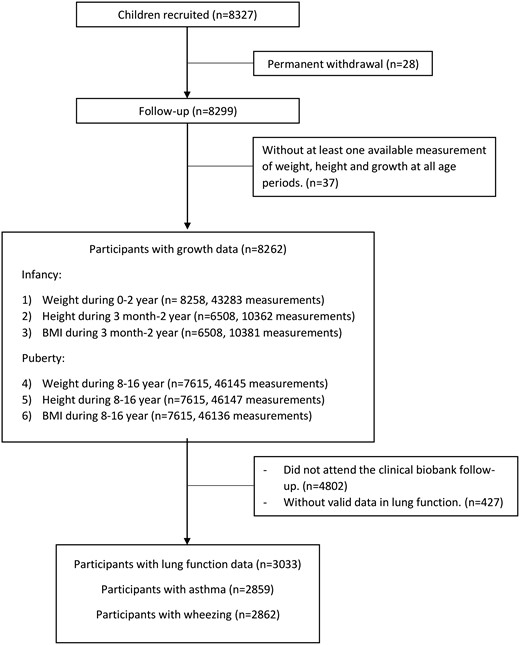
Association of growth patterns during infancy and puberty with lung function, wheezing and asthma in adolescents aged 17.5 years: evidence from ‘Children of 1997’ Hong Kong Chinese Birth Cohort

alexandrossfakianakis shared this article with you from Inoreader

m_dyac182f1.jpeg?Expires=1727190020&Sign

Abstract
BackgroundRapid growth is related to adverse respiratory outcomes although possibly confounded or limited by growth modelling methods. We investigated the association of infant and pubertal growth with lung function, wheezing and asthma in a non-Western setting.
Methods
In Hong Kong's 'Children of 1997' Chinese birth cohort (n = 8327), weight during infancy and weight, height and body mass index (BMI) during puberty were modelled using a super-imposition by translation and rotation model to identify (larger or smaller) size, (earlier or later) tempo and (slower or faster) velocity. Sex-specific associations with forced vital capacity (FVC), forced expiratory volume in the first second (FEV1), FEV1/FVC (Global Lung function Initiative z-score) and self-reported wheezing and asthma at ∼17.5 years were assessed.
Results
For each fraction higher than average weight growth velocity during infancy, FVC w as higher in boys (0.90 SD, 95% CI 0.35; 1.44) and girls (0.77 SD, 95% CI 0.24; 1.30), FEV1/FVC was lower (–0.74 SD, 95% CI –1.38; –0.10) and wheezing was higher (odds ratio 6.92, 95% CI 1.60; 29.99) in boys and an inverse association with FVC was observed for tempo but not for size. Associations for weight growth velocity in puberty were similar but weaker. Greater size and higher velocity of BMI growth was associated with higher FVC, lower FEV1/FVC and higher asthma and wheezing risk.
Conclusion
Accelerated infant and pubertal weight growth were associated with disproportionate lung size and airway growth, and higher risk of asthma; optimizing early-life growth patterns could be important.
View on Web

Πέμπτη 22 Σεπτεμβρίου 2022

Vaccine‐induced binding and neutralizing antibodies against Omicron 6 months after a homologous BNT162b2 booster

alexandrossfakianakis shared this article with you from Inoreader

Abstract

Introduction

Evidence about the long-term persistence of the booster-mediated immunity against Omicron is mandatory for pandemic management and deployment of vaccination strategies.

Methods

A total of 155 healthcare professionals (104 COVID-19 naive and 51 with a history of SARS-COV-2 infection) received a homologous BNT162b2 booster. Binding antibodies against the spike protein and neutralizing antibodies against Omicron were measured at several time points before and up to 6 months after the booster. Geometric mean titers of measured antibodies were correlated to vaccine efficacy against symptomatic disease.

Results

Compared to the highest response, a significant 10.2 and 11.5-fold decrease in neutralizing titers was observed after 6 months in participants with and without history of SARS-CoV-2 infection. A corresponding 2.5 and 2.9-fold decrease in binding antibodies was observed. The estimated T1/2 of neutralizing antibodies in pa rticipants with and without history of SARS-CoV-2 infection was 42 (95%CI, 25–137) and 36 days (95%CI, 25–65). Estimated T1/2 were longer for binding antibodies: 168 (95%CI, 116–303) and 139 days (95%CI, 113–180), respectively. Both binding and neutralizing antibodies were strongly correlated to vaccine efficacy (r = 0.83 and 0.89). However, binding and neutralizing antibodies were modestly correlated, and a high proportion of subjects (36.7%) with high binding antibody titers (i.e. > 8,434 BAU/mL) did not have neutralizing activity.

Conclusion

A considerable decay of the humoral response was observed 6 months after the booster, and was strongly correlated with vaccine efficacy. Our study also shows that commercial assays available in clinical laboratories might require adaptation to better predict neutralization in the Omicron era.

This article is protected by copyright. All rights reserved.

View on Web

Longitudinal Effects of Base of Tongue Concurrent Chemoradiation Therapy in a Pre‐Clinical Model

alexandrossfakianakis shared this article with you from Inoreader
Longitudinal Effects of Base of Tongue Concurrent Chemoradiation Therapy in a Pre-Clinical Model

We present a clinically relevant animal model quantifying the effects of concurrent chemoradiation therapy (CCRT) on tongue strength and elasticity over time. This study demonstrates an increasing difference in tongue strength over time between control animals and those exposed to CCRT. Tongue elasticity was not significantly affected by CCRT, suggesting that changes in strength may not be caused by fibrosis during the time period studied.


Background/Objectives

Base of tongue (BOT) dysfunction is common following oropharyngeal concurrent chemoradiation therapy (CCRT). We present a clinically relevant animal model quantifying the effects of CCRT on tongue strength and elasticity over time.

Methods

Fifty-three male and 53 female Sprague–Dawley rats were randomized to control or experimental groups. Experimental animals received cisplatin, 5-fluorouracil, and 5 fractions of 7 Gy directed to the BOT. Controls received no intervention. At 2 weeks, 5 months, or 10 months after CCRT, animals underwent non-survival surgery to measure twitch and tetanic tongue strength, which were analyzed using multivariate linear mixed effects models. Tongue displacement, a surrogate for tongue elasticity, was also determined via stress–strain testing and analyzed via a multivariate linear mixed effects model.

Results

Reporting the combined results of both sexes, the estimated experimental group mean peak twitch forces became more divergent over time compared to controls, being 8.3% lower than controls at 2 weeks post-CCRT, 15.7% lower at 5 months, and 31.6% lower at 10 months. Estimated experimental group mean peak tetanic forces followed a similar course and were 2.9% lower than controls at 2 weeks post CCRT, 20.7% lower at 5 months, and 27.0% lower at 10 months. Stress–strain testing did not find CCRT to have a significant effect on tongue displacement across experimental timepoints.

Conclusions

This study demonstrates an increasing difference in tongue strength over time between controls and animals exposed to CCRT. Tongue elasticity was not significantly affected by CCRT, suggesting that changes in strength may not be caused by fibrosis.

Level of Evidence

NA Laryngoscope, 2022

View on Web

Cetuximab-Based vs Carboplatin-Based Chemoradiotherapy for Patients With Head and Neck Cancer

alexandrossfakianakis shared this article with you from Inoreader

jamanetwork.com

This cohort study compares survival with cetuximab-based and carboplatin-based chemoradiotherapy in locally advanced head and neck squamous cell carcinoma.
View on Web

Validation of Pain Catastrophizing Scale on Breast Cancer Survivor

alexandrossfakianakis shared this article with you from Inoreader

Abstract

Introduction

Pain Catastrophizing Scale (PCS) is the most used scale to measure pain catastrophizing. In breast cancer survivors (BCS), pain catastrophizing is related to upper-limbs dysfunction and disability. This study aimed to assess the internal consistency, internal structure and convergent validity of the Spanish version of the PCS in Spanish BCS

Material and Methods

BCS were recruited from the service of Medical Oncology of the University Clinical Hospital Virgen de la Victoria, in Málaga (Spain). The psychometric properties were evaluated with analyses factor structure by maximum likelihood extraction (MLE), internal consistency, and construct validity by confirmatory factor analysis (CFA).

Results

Factor structure was three-dimensional, and one item was removed due to cross-loading. The new 12-items PCS showed a high internal consistency for the total score (α=0.91) and a good homogeneity, and CFA revealed a satisfactory fit. PCS showed an acceptable correlation with FACS (r=0.53, p<0.01)

Conclusion

PCS is a valid and reliable instrument to evaluate pain catastrophizing in Spanish BCS. This tool may help clinicians in the management of pain by assessing pain and by measuring the effect of interventions.

View on Web

Perspectives from recent advances of Helicobacter pylori vaccines research

alexandrossfakianakis shared this article with you from Inoreader

Abstract

Background

Helicobacter pylori (H. pylori) infection is the main factor leading to some gastric diseases. Currently, H. pylori infection is primarily treated with antibiotics. However, with the widespread application of antibiotics, H. pylori resistance to antibiotics has also gradually increased year by year. Vaccines may be an alternative solution to clear H. pylori.

Aims

By reviewing the recent progress on H. pylori vaccines, we expected it to lead to more research efforts to accelerate breakthroughs in this field.

Materials & Methods

We searched the research on H. pylori vaccine in recent years through PubMed®, and then classified and summarized these studies.

Results

The study of the pathogenic mechanism of H. pylori has led to the development of vaccines using some antigens, such as urease, catalase, and heat shock protein (Hsp). Based on these antigens, whole-cell, subunit, nucleic acid, vector, and H. pylori exosome vaccines have been tested.

Discussion

At present, researchers have developed many types of vaccines, such as whole cell vaccines, subunit vaccines, vector vaccines, etc. However, although some of these vaccines induced protective immunity in mouse models, only a few were able to move into human trials. We propose that mRNA vaccine may play an important role in preventing or treating H. pylori infection. The current study shows that we have developed various types of vaccines based on the virulence factors of H. pylori. However, only a few vaccines have entered human clinical trials. In order to improve the efficacy of vaccines, it is necessary to enhance T-cell immunity.

Conclusion

We should fully understand the pathogenic mechanism of H. pylori and find its core antigen as a vaccine target.

View on Web

Τετάρτη 21 Σεπτεμβρίου 2022

Incidence of occult cleft palate on prenatal magnetic resonance images obtained for non-cleft indications

alexandrossfakianakis shared this article with you from Inoreader
Prenatal diagnosis of craniofacial anomalies has improved family education and preparedness. Isolated cleft palate, however, remains difficult to identify sonographically. The aim of this study was to investigate the rate of incidental cleft palate identified on fetal magnetic resonance imaging (MRI) following the ultrasound detection of non-cleft abnormalities. This was a retrospective study of pregnant women who had fetal MRI performed between 2003 and 2017. To be included, the woman had to have been referred for fetal imaging for a non-cleft indication, with subsequent identification of an isolated cleft palate on MRI. (Source: International Journal of Oral and Maxillofacial Surgery)
View on Web