Αρχειοθήκη ιστολογίου

Αλέξανδρος Γ. Σφακιανάκης
ΩτοΡινοΛαρυγγολόγος
Αναπαύσεως 5
Άγιος Νικόλαος Κρήτη 72100
2841026182
6032607174

Δευτέρα 11 Ιουλίου 2022

Extramedullary focal fat - fluid level, a specific sign of osteomyelitis

Balaji Anvekar's Neuroradiology Cases

________________________________

Extramedullary focal fat - fluid level, a specific sign of osteomyelitis

Posted: 11 Jul 2022 09:37 PM PDT

 A 14 yo male with pain in calcaneum since 1months.
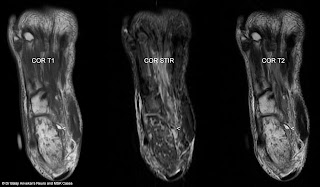

MRI foot for calcaneum with CT correlation shows:

Heterogeneous signal abnormality diffusely involving calcaneum with multiple low signal intensity foci diffusely scattered in calcaneum on T1-weighted images which are hyperintense on STIR. Rest of the intervening calcaneum medulla shows faint high signal on STIR.

No obvious density abnormality on CT. No obvious sclerotic or lytic lesion. No obvious cortical destruction or sclerosis.

There is a focal lentiform shaped parosteal collection measuring approximately 26 mm in height and 6 mm in thickness medially at 2 o'clock position and 4 mm in thickness laterally on plantar aspect at 7 o'clock position on axial section.

There is fat – fluid level within this collection, focal fat in the supernatant portion of this collection which is hyperintense on T1-weighted images with complete signal suppression on STIR, this portion follows classical fat density on CT.

There is an associated diffuse oedema involving muscles of plantar aspect of foot especially quadratus plantae muscle, medial as well as lateral teno synovitis.

This finding suggestive of extramedullary focal fat - fluid level which is a pathognomonic sign of acute to subacute osteomyelitis.

Findings were discussed with the referring physician before finalizing the report, who added that there is elevation of inflammatory markers in lab reports and the suspicion of osteomyelitis clinically as well, with a feedback of significant improvement clinically after IV antibiotics.

Take home note is during MSK MRI interpretation, a bone marrow signal abnormality with an associated focal periosteal extra medullary fat – fluid level, osteomyelitis should be in the list of your differential diagnosis.

References:

1. Extra-osseous fat fluid level: a specific sign for osteomyelitis. Kumar J, Bandhu S, Kumar A, Alam S. Skeletal Radiol. 2007 Jun;36 Suppl 1:S101-4. doi: 10.1007/s00256-006-0194-1. Epub 2006 Sep 19.

2. Intramedullary and extramedullary fat globules on magnetic resonance imaging as a diagnostic sign for osteomyelitis. Davies AM, Hughes DE, Grimer RJ. Eur Radiol. 2005 Oct;15(10):2194-9. doi: 10.1007/s00330-005-2771-4. Epub 2005 Apr 29.


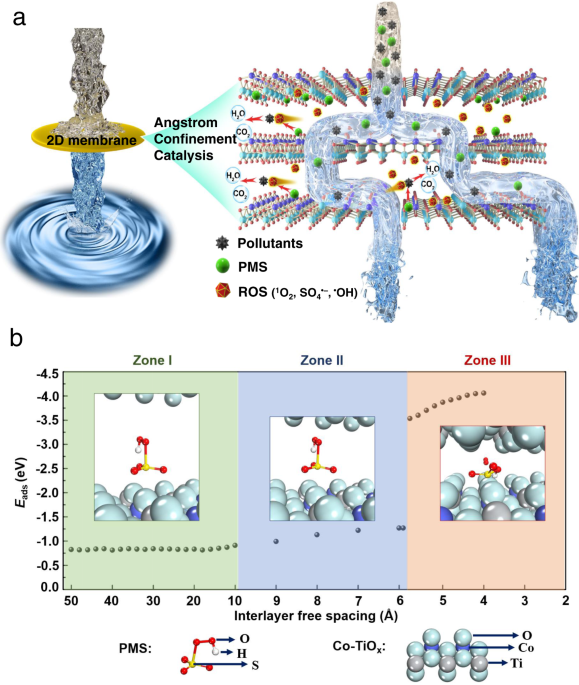
Angstrom-confined catalytic water purification within Co-TiOx laminar membrane nanochannels

alexandrossfakianakis shared this article with you from Inoreader

41467_2022_31807_Fig1_HTML.png

View on Web

Intrathecal Fluorescein for CSF Leak Detection

alexandrossfakianakis shared this article with you from Inoreader
2021-38-Image-S450.jpg

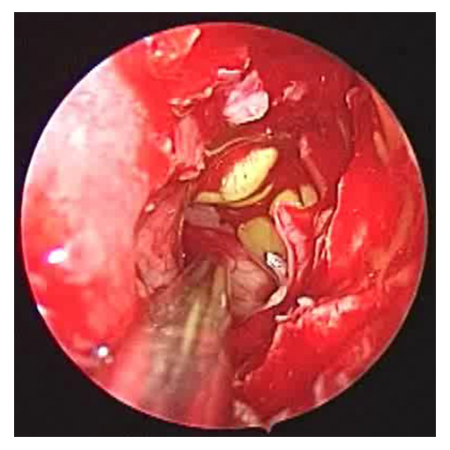
J. Paul Radabaugh (former rhinology fellow at McGovern Medical School) presented the results of a retrospective study of intrathecal fluorescein (IF) use for detection of cerebrospinal fluid leaks (CSF) at the American Rhinology Society annual meeting in Los Angeles. The...
View on Web

Κυριακή 10 Ιουλίου 2022

Abutment mechanical complications of a Morse taper connection implant system: A 1‐ to 9‐year retrospective study

alexandrossfakianakis shared this article with you from Inoreader

Abstract

Background

The fracture of a Morse tapered abutment connection in an osseointegrated implant is one of the most serious mechanical complications, and it is extremely hard to deal with this complication in clinical practice.

Purpose

The aim of this study was to explore the cumulative mechanical complications focus on abutment of a platform switching Morse taper connection implant system after loading, and to perform a retrospective, approximately 1- to 9-year follow-up study to identify the predisposing factors.

Materials and Methods

A total of 495 patients with 945 fitted implants were enrolled in this study with a follow-up from January 2012 to January 2020. The data of mechanical complications of the abutment, including abutment fracture (AF) and abutment screw loosening (ASL), and possible causative factors were extracted and evaluated statistically.

Results

A total of 25 out of 945 (2.65%) cumulative abutment mechanical complications occurred. AF was the most common complication (n = 13, 1.38%), followed by ASL (n = 12, 1.27%). For AF, gender, type of prosthesis, abutment design, and implant diameter were identified as the causative factors. AF was mostly observed in the single crown of males in molar areas, while ASL was more likely to occur on an angled abutment than on a non-angled abutment. Moreover, the abutment with the positioning index (/X) had a higher incidence of fracture than the abutment without the positioning index (C/).

Conclusions

This study shows that the Morse taper connection is a safe abutment connection. AF occurs more frequently within single crowns in molar area of males, especially with the positioning index (/X), while ASL is more likely to occur in an angled abutment.

View on Web

Characterizing the Relationship Between Reflection and Distortion Otoacoustic Emissions in Normal-Hearing Adults

alexandrossfakianakis shared this article with you from Inoreader
AbstractOtoacoustic emissions (OAEs) arise from one (or a combination) of two basic generation mechanisms in the cochlea: nonlinear distortion and linear reflection. As a result of having distinct generation processes, these two classes of emissions may provide non-redundant information about hair-cell integrity and show distinct sensitivities to cochlear pathology. Here, we characterize the relationship between reflection and distortion emissions in normal hearers across a broad frequency and stimulus-level space using novel analysis techniques. Furthermore, we illustrate the promise of this approach in a small group of individuals with mild-moderate hearing loss. A "joint-OAE profile" was created by measuring interleaved swept-tone stimulus-frequency OAEs (SFOAEs) and 2f1-f2 distorti...
View on Web

Real‐life impact of tenofovir disoproxil fumarate and entecavir therapy on lipid profile, glucose and uric acid in chronic hepatitis B patients

alexandrossfakianakis shared this article with you from Inoreader

Abstract

Background & Aims

The impact of long-term nucleos(t)ide analogs treatment on host metabolism is a concern. Hence, we conducted this study to compare the effect of entecavir (ETV) and tenofovir disoproxil fumarate (TDF) on metabolic parameters among CHB patients.

Methods

In this real-life retrospective study, 2,030 CHB outpatients treated with ETV or TDF at Nanfang Hospital, China, were included. For treatment-naïve patients, pretreatment and semiannual metabolic parameters were collected. For treatment-experienced patients, metabolic parameters were collected at the first visit. Propensity score matching (PSM) was used to balance the effects of potential confounding factors.

Results

Among 122 treatment-naïve patients and 1908 treatment-experienced patients, ETV-treated patients were older with a higher percentage of metabolic syndrome. After PSM, the characteristics were comparable between the two groups. For treatment-naïve patients, fou r lipid parameters, including total cholesterol (TC), low-density lipoprotein (LDL), high-density lipoprotein and triglyceride levels showed a decreasing trend during the 42-month TDF treatment, while they remained relatively stable or increased during ETV treatment. At month 30, the levels of TC and LDL among TDF-treated patients were significantly lower than those among ETV-treated patients (TC: 4.7 vs. 3.9 mmol/L, p=0.004; LDL: 3.0 vs. 2.4 mmol/L, p=0.009). For treatment-experienced patients, we also observed lower levels of lipid parameters in patients with different durations of TDF treatment. The levels of glucose and uric acid were similar among ETV- and TDF-treated patients.

Conclusion

TDF has a lipid-lowering effect in CHB patients, which provides a basis for the selection of antiviral drugs for aging CHB patients.

This article is protected by copyright. All rights reserved.

View on Web

A seroepidemiological study across age groups before and after the 2010–2011 mumps epidemic in Japan

alexandrossfakianakis shared this article with you from Inoreader

Abstract

In Japan, large-scale mumps epidemics recur every 4–6 years because of low vaccination coverage. This study aimed to describe the seroprevalence of mumps in the Japanese population and identify the age groups most affected. The prevalence of anti-mumps antibodies was evaluated based on 1000 serum samples obtained from the Japanese National Serum Reference Bank. These samples consisted of 50 sera for each of 10 different age groups, collected during 2007–2008 (pre-epidemic period) and 2012–2013 (post-epidemic period). Seropositivity was lowest in the 6–11 months subgroup (3% and 0% in pre- and post-epidemic periods, respectively) and highest in the 10–14 years group (66% and 72% in pre- and post-epidemic periods, respectively). A comparison of anti-mumps antibody prevalence throughout the two periods considered revealed a large rise seropositivity among the 2004–2008 birth cohort, using that of the 1–4 years group as representative in the pre-ep idemic period (from 22% in pre- to 58% in post-epidemic periods) (P=0.0002). These results indicate that most people likely gain antibodies to the mumps virus during their childhood, especially during the first epidemic that they experience after their second year of life. Therefore, children should be vaccinated against mumps soon after their first birthday for effective prevention.

This article is protected by copyright. All rights reserved.

View on Web